AI cheating is everywhere, but not all AI use is cheating.
Don't let the machines do your thinking for you, but don't throw the baby robot out with the bathwater

In many circles, everyone claims to hate AI, while everyone still seems to be using it to cheat.
The New York Times cut ties with a reviewer whose AI-written review plagiarized another review, and the NYT and WSJ likely have AI-written material across their op-ed and news pages.
Three out of five winners of the Commonwealth Short Story Prize appear to be AI-generated, and one of the winners may be a false persona created with AI.
The novel “Shy Girl” was pulled when the book was revealed as likely AI-written, and a book on post-AI truth has AI hallucinations.
51% of college students think using AI is cheating, but 22% admit to doing it anyway.
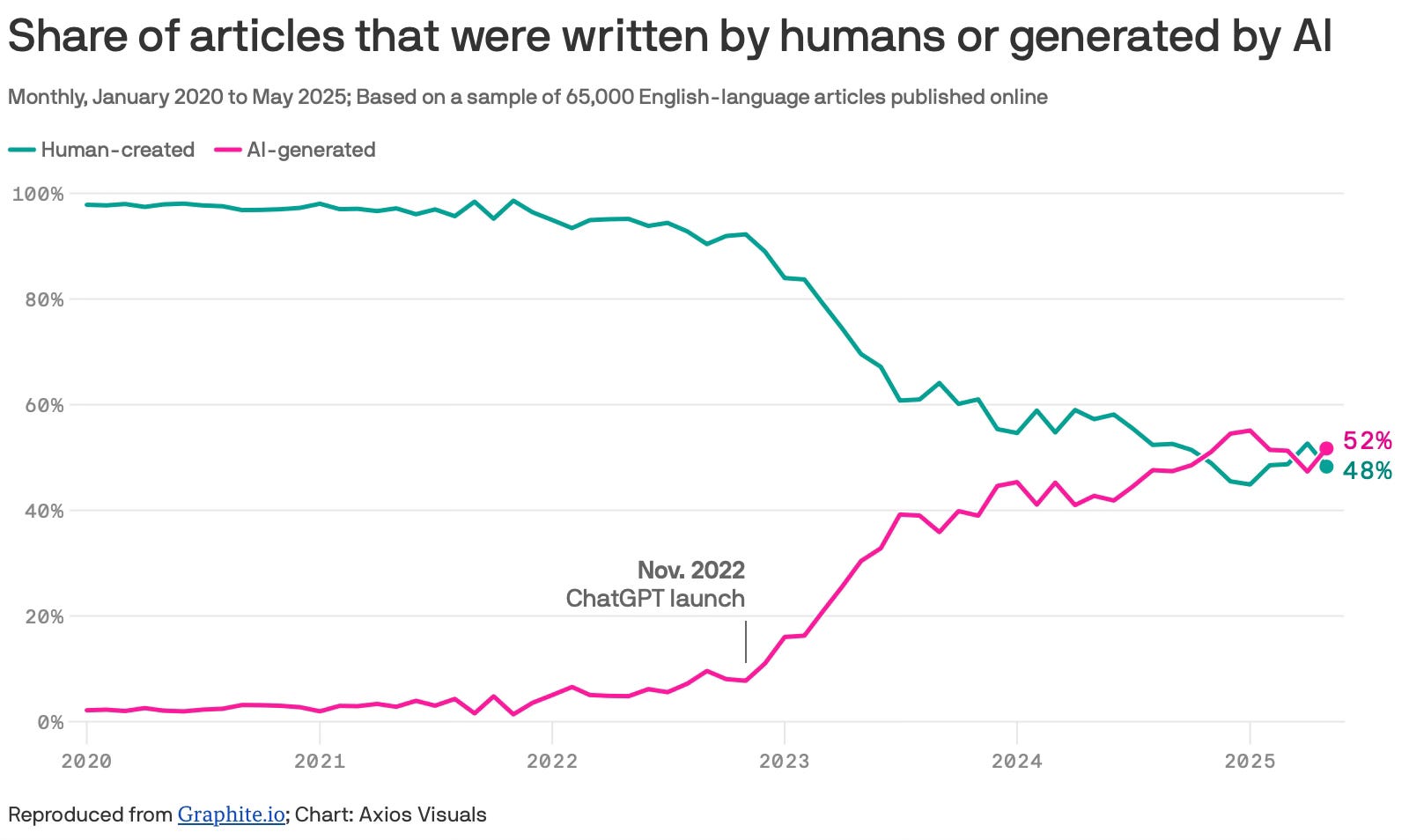
52% of new articles on the Internet are being written by AI. (You got lucky, this article is human-written)
I suspect most examples of passing off AI work as human are going undetected, and the lines can also be blurred with people using it in different ways during their process. You can ask AI to run a more sophisticated context-dependent spellcheck, or you can have it fill out your writing with slop in a style everyone is growing familiar with.
I think a lot of AI usage is net negative, as the commons are becoming flooded with unmetered AI outputs less connected to any human reality. But I think other uses are perfectly reasonable: the Nobel laureate Olga Tokarczuk recently landed in hot water with an article suggesting she “used AI to write her latest novel”, when all she claims to have done was use it in the same way she would use a search engine. It’s becoming impossible to use any software product without AI being involved somehow, and we are going to need some finer lines around what responsible use is.
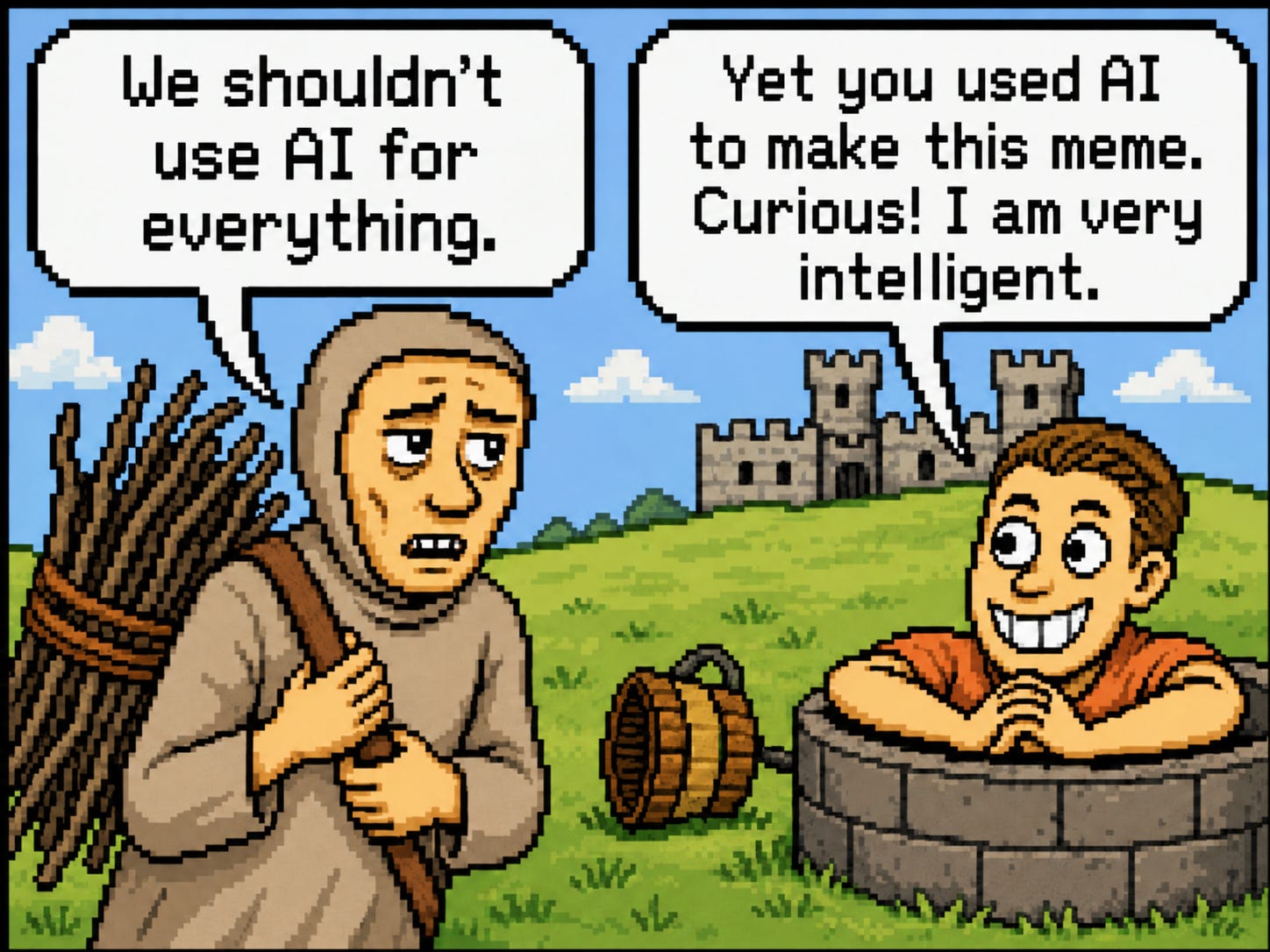
Everyone using more AI than me is a hack, everyone using less AI than me is a Luddite
Some people are categorically against AI because of its environmental impact. My understanding is that the water usage is generally overstated, and that in other areas we should follow the overwhelming economic consensus in favor of carbon taxes, and price in the social cost of any environmental impacts. I don’t really like the Transformers movies, but it would be silly for me to object to them on the grounds of their carbon footprint when I don’t apply that standard anywhere else.
Some people think AI is capable of generating true art, and all the gatekeeping is elite snobbery comparable to rejecting photography. I am in basic agreement with Brandon Sanderson that haggling with an AI to get the image you want can feel like making art, but it’s most analogous to being an art director, working through rounds of feedback like George Lucas iterating on designs with his team to produce a cantina full of aliens. That said, even Ted Chiang’s essay against AI art is willing to carve out an exception that a human can work enough with an AI tool in making unique choices to create something that could be called art, even if the vast majority of use cases don’t match that level of craft or intention.
Some people are against AI because it might kill us all, a risk taken seriously by a majority of AI researchers. Maybe the experts and Biden’s FTC chief have all succumbed to a collective hallucination induced by Harry Potter fan fiction, but powerful new technologies having significant risks seems like the expected result. Even so, I don’t know that keeping AI tools out of civilian hands is going to help anything.
My own perspective is that AI tools have significant advantages and significant dangers. Not even Sam Altman of OpenAI wants to read other people’s ChatGPT conversations, there is no comparative advantage for a human to parrot AI outputs to someone else in the most overdone writing style on the planet. Even gazing into its Palantir for insight can end up warping your perspective, as it slyly nudges you towards the worldview it synthesized from the Internet’s shadow. The tools are too powerful to never make use of them, but I think it’s worth having some hard lines for what you want to get out of them, and what you want to be responsible for yourself.
AI as an editor vs feedback provider
I think using AI to directly edit prose carries a lot of risk, and the line between asking AI to edit text and prompting it to write something for you is blurry. One study showed AIs often directly change the meaning of text even when they’re asked to only make grammatical edits, and some of the recent AI cheating scandals have fallen back to people claiming they only used AI for “editing”.
I think the more responsible practice is to ask an AI for detailed point-by-point feedback, but own the final copy on all language yourself, treating it as an extremely available but biased early reader. As I’ve started to run completed posts past AI for a round of feedback, it’s found subtle grammatical mistakes or inconsistencies in usage I would have missed, while also making suggestions that would change my meaning or weaken the rhythms in writing I was trying for, as well as simply being wrong sometimes. My line in the sand is that I can be interested in an AI’s opinion, but I need to type every word myself and be convinced I picked the right one.
I wouldn’t demand that someone should write without spellcheck or grammar check, but I also wouldn’t expect someone to blindly accept every suggestion when even those tools can make mistakes due to lack of context. Similarly, I think you can use AI to kick off research the same way you would use Wikipedia or a search engine, knowing that it would be irresponsible to use its results as a primary source, and keeping in mind that what you are getting will have biases.
Don’t let the AIs think for you
I have friends I am dead certain are currently writing their LinkedIn posts with AI. (If that’s you and you’re reading this, we should catch up sometime!) I’ve gotten fully AI-written emails from people I’ve known for years, from strangers wanting to do business with me, and I’ve been asked to sign AI-written contracts my own AI told me were wildly nonstandard and which even typing this sentence might have left me in breach of, had I signed.
Writing is a difficult skill basically nobody masters. But it’s also hard because thinking is hard. In one of the more prescient stories about AI written by Scott Alexander of Astral Codex Ten fame, a treasure vault holds a Whispering Earring that offers advice which is never wrong.
When worn, it whispers in the wearer’s ear: “Better for you if you take me off.” If the wearer ignores the advice, it never again repeats that particular suggestion.
If you ignore the earring’s first recommendation, it will continue to advise you until you outsource your entire cognitive capacity to it, as your own will and independence atrophy in favor of following its superior advice.
Writing can be painful because thinking can be painful, and asking AI to directly edit your work, rephrase your thoughts, or help you brainstorm is often asking AI to think for you. The resulting output will often be pretty good, better than you could have done without a lot of work. But the result will be less uniquely you. When I see people I know writing with AI on social media, what I actually want to know is “what prompt did you give the AI? What piece of you is in this giant wall of text? Who are you under the mask?”
Fingerprinting AI vs human writing
There’s currently a Substacker ironically vowing to murder people who write with AI, while other writers argue it’s no one’s business how the sausage is made. Even for those of us whose dislike for AI writing falls short of homicidal rage, an AI-influenced writing style is becoming a negative signal for quality, like seeing an essay littered with misspellings and grammatical mistakes. AI outputs are so low-cost to create I've come to associate AI tells with low-quality work made with minimal intention. And even within organizations that ban AI use without disclosure, people continue to get caught using it.
Hypocrisy and false attribution are as old as the Bible itself; some early church writings like the Apostolic Constitutions warn their readers against the evils of people passing off their work as something it’s not, while doing the same thing themselves. It can be completely consistent with your professional incentives to publicly restrict AI usage and oppose automation in your sector, while also smuggling it into your own work.
I don’t know how we solve this long-term. Maybe the New York Times will force its writers into Faraday cages where they plunk out text on typewriters to avoid AI plagiarism scandals. Maybe we just reject text without a chain of custody; Substack keeps a version history that could likely serve as solid proof I typed every word of these posts myself, perhaps word processors will evolve to certify artisanal human-produced text by capturing all the inputs to show nothing was copy-pasted, as all text comes with an audit log showing just how indecisive you are as a writer, giving us another six months of runway before the AIs learn to fake that too.
Maybe we’ll create hardware-encrypted audit logs to certify 100% organic human-created text which the creative professions will rally around. But the technology might also advance quickly enough that we may hit the point where people stop caring about filtering against AI, if AI keeps winning in match-ups against humans.
Much of this only matters if we don’t hit superintelligence
A number of people in the arts are buying into a philosophy that AI can never replace them because AI has inherent limitations pushing it to the average of all outputs, and the human perspective will remain unique. The short story contest AI won was from a hollowed-out institution, the experts who favored fine-tuned AI writing in direct matchups are uncultured swine, no one of any taste or ability likes the thing that keeps winning, the real art is taping bananas to walls.
I would also like to believe this. But the arts are a shrinking elite profession incentivized to puff up its own importance, as a smaller and smaller number of people make a career out of writing in a world where literacy continues to drop as short-form video conquers the world. The stakes are low, there are already publications with more submissions than readers, writers writing for writers who write for writers.
I am not convinced that current AI tells and stylistic flattening will be inevitable forever, as AI has continued to improve at making images with dynamic styles that avoid previous tells, and has started to master domains like coding and Go where it avoids the pitfall of trending towards the average. We might see a long plateau where humans remain on top. Or we might be in the middle of a takeoff where the war for attention is won by the machines, and human-created anything becomes a luxury good.
Maybe we’ve been here before
As computer-generated characters and effects were proven out in movies, there was a wave of CGI adoption which opened up new possibilities, and was sometimes decried as looking cheap and artificial, unnaturally sterile and clean compared to the previous craft. Some directors eventually leaned into a mix of CGI and practical effects to get the best of both worlds, and I don’t know that fighting the adoption of new technology has ever been a winning strategy.
I’m not sure if there’s a principled line in the sand to say that a video game with gigabytes of art assets needs human chain of custody on every texture, or that it matters whether a world uses procedurally generated foliage from algorithms that have existed for years compared to modern generative AI.
For a novel or an essay, every part of the experience being crafted with intention affects my experience a lot, I don't want to focus my attention on something that did not take attention to create. For a non-linear multimedia game costing hundreds of millions of dollars with more data than I could ever personally take in, I’m less allergic to the idea of AI assisting to fill in background details in areas where the historic precedent has been procedural generation. Books and essays are wildly oversupplied, while some game series that used to make a title every year now go seven years between installments in part due to the cost of high-fidelity art assets often absorbed in the periphery of attention. I think a balance could be struck comparable to mixing CGI and practical effects, where a core experience remains 95% crafted by humans at higher scale than is currently being achieved, as opposed to insisting on anti-AI purism for the whole medium.
Anti-AI purism is probably unworkable
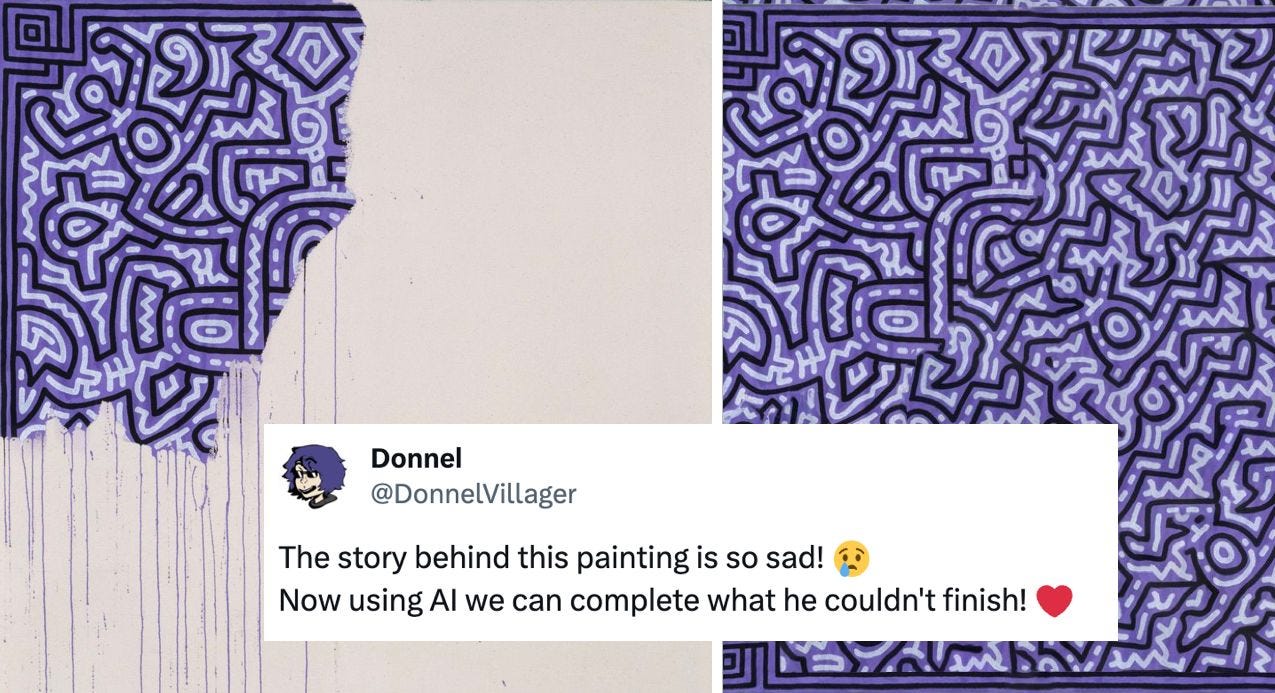
Someone crafting images rather than prose might have the opposite take and be fine with AI text while hating AI images, and think Substackers who throw up placeholder AI images for visual interest on free publications are betraying an artistic legacy going back to the first cave painting. They probably have a point. And if I try to see past my own personal hang-ups over AI text, I had someone I know closely tell me they love how AI helps them explore and express ideas, I’ve heard from someone that AI writing helps them handle their dyslexia and increase their confidence in communicating, and I had someone tell me they hope AI improves social justice by achieving universal translation of dialect and tone that has been a barrier to people like them. (That last person was still more worried about the AI arms race destroying humanity, just so the stakes are clear)
AI-derived works will not be alone in combining low status with popularity. Memes, fan art, and fan fiction are also highly derivative works that take advantage of someone else’s artistic vision as a launching point for expressing something. We’re already in the era where stories that started as fan fiction have become bestsellers or popular movies with the serial numbers filed off, and I would expect AI-derived art to follow a similar path. I may not want to spend hours crawling fan fiction sites or reading people’s AI-written stories or looking at their AI art, but there may be some cream that rises to the top, and is subsequently revised into a form seen as more legitimate, or some of it may simply succeed on its own merits.
I do not think the genie is ever going back into the bottle. I still think you should try to do the difficult work of thinking for yourself, expressing your own ideas, and showing yourself to the world without a superimposed filter that makes you look and sound like everyone else. But if I flinch for a moment at my own hypocrisy in still making memes rather than mastering visual art, life is short, time is limited, and all technology risks hollowing out the soul as you take the easy path.
You could argue that the first writer who plucked a word from a thesaurus at random rather than waiting for inspiration was betraying their muse with an algorithm, and everything from Photoshop auto-fill to CG model-rigging is on a continuum of selling out the craft by making it easier to make things faster, turning the arts into a market for lemons if we lose our ability to distinguish high-quality work and let the tools flood the commons with lazy slop.
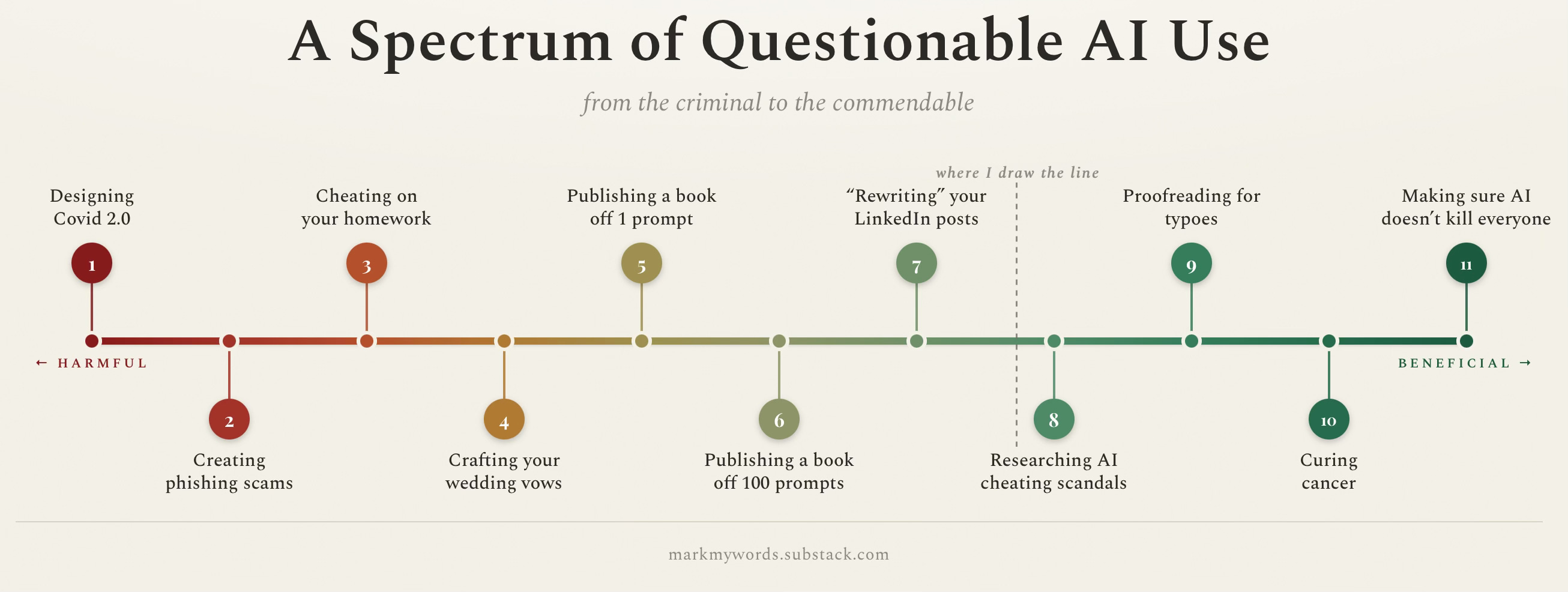
The universal principle I think we should hold to on AI use is transparency, which the examples of cheating I started with clearly fail on. I think AI has its place (proofreading and research for me), but you need to be wary of the failure mode where it becomes a scheming vizier pulling the strings of a feeble monarch, sapping your will as you become its vessel in this world. You will never be better than ChatGPT at being ChatGPT. But you might be better at being yourself.
Man, this is a tough one for me. Full disclosure, I've used AI extensively on my latest novel--not to craft any particular sentence, or even to edit, but I have used it quite a bit to do a lot of my research, and far beyond "search engine" applications. Think "evaluate the plausibility of this scene" or "what kind of audience would this work appeal to?" or "pretend to be such-and-such a character, and try to convince me as so-and-so to do x." I even had AI give me developmental feedback. A year ago, most feedback was sycophantic to the point of being nearly useless, but lately, it's gotten surprisingly good. Too good, in fact, to the point where I did start to feel like I was cheating and the work, on a macro scale, was in danger of losing something. Or maybe I sensed that *I* was losing something. So I think my line in the sand might be in the arena of developmental feedback, where editors and beta readers should live, even if the process is many times slower and more imprecise. Still haven't made up my mind about AI. All of this is moving faster than I can keep up with.
I appreciate the custom charts that go along with every post.
I think the part I'd push back on about the cream rising to the top is that we are seeing a potentially higher volume of fluid that the cream has to rise through than ever before. While pre-ai CGI was faster than painting or making the props it was still within one order of magnitude. Clarkesworld had to close its submissions because they received such a huge volume of AI generated stories and that was back when AI was worse and had lower penetration in the public consciousness
https://www.npr.org/2023/02/24/1159286436/ai-chatbot-chatgpt-magazine-clarkesworld-artificial-intelligence
I'm sure good art will still be made and I'm sure some of it will use AI in some capacity or another but being a writer who gets lucky and has their fanfiction (or maybe any fiction) hit the big time is/will be a lot harder